


The Mayflower Compact: "For the glory of God and advancement of the Christian faith"
- innerweavings
- Nov 21, 2019
- 3 min read
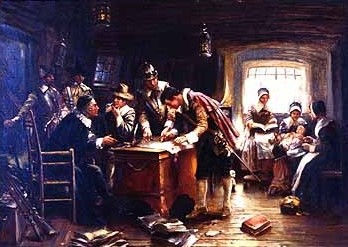
On November 21, 1620, the passengers aboard the Mayflower anxiously wondered what awaited them in the New World they had crossed an ocean to reach and which was now just a few steps away. Blown off course, they were far north of their intended destination in Virginia and out of the legal jurisdiction of the King of England. They were literally in a No Man’s Land with no established Government or rule of law and the dead of winter was fast approaching.
Aboard the ship “there were those even among the Pilgrims , who threatened that when they came to ashore, where none had the power to command them, they would use their own liberty for their own ends and advancement.” It looked as if they were doomed to be thrown into a real-life Darwinian “survival of the fittest” experiment.
But the godly men aboard the Mayflower who had risked everything for religious freedom took to heart the warning of Galatians 5:13 “For you, brethren, have been called to liberty; only do not use liberty as an opportunity for the flesh, but through love serve one another.” But how were they to accomplish this?
Though the idea of self-government is commonplace since 1620, the course of action those men decided upon was revolutionary. They made an agreement, a Compact, stating their purpose and establishing the foundation of self-government. To this Compact, all forty-one of the male passengers of legal age and right, affixed their names. This simple document was the basis for all the following laws which would be passed in Plymouth Colony and served its inhabitants well for the challenging decades to come. It laid the foundation for our own Constitution and established the principle that people of goodwill could rule themselves IF
- They had an honorable purpose: “for the glory of God, and advancement of the Christian faith, and honor of our King and Country.”
- They had respect for the rule of law and rightful authority: “the loyal subjects of…King James.”
- They recognized their rights and responsibility to God and others: “in the presence of God, and one of another, covenant and combine our selves together into a civil body politic.”
- They understood the purpose of Government was not to serve as a master, but to protect the rights of the citizens in order to master themselves: “covenant and combine our selves together into a civil body politic, for our better ordering and preservation and furtherance of the ends aforesaid.”
- They understood that while the foundational framework must be firm, it must also be flexible enough for individual laws to be crafted – and adjusted – for specific needs and situations: “by virtue hereof to enact, constitute, and frame such just and equal laws, ordinances, acts, constitutions and offices, from time to time, as shall be thought most meet and convenient for the general good of the Colony.”
Let us thank God today for these brave men who put their faith into practice and provided such a groundbreaking example of godly leadership and self-government! As Christians, and as Americans, our lives are inextricably “innerwoven” in the great work they did and we have been unbelievably blessed by their wisdom, humility and foresight.
Full text of the Mayflower Compact:
In the name of God, Amen. We whose names are under-written, the loyal subjects of our dread sovereign Lord, King James, by the grace of God, of Great Britain, France, and Ireland King, Defender of the Faith, etc.
Having undertaken, for the glory of God, and advancement of the Christian faith, and honor of our King and Country, a voyage to plant the first colony in the northern parts of Virginia, do by these presents solemnly and mutually, in the presence of God, and one of another, covenant and combine our selves together into a civil body politic, for our better ordering and preservation and furtherance of the ends aforesaid; and by virtue hereof to enact, constitute, and frame such just and equal laws, ordinances, acts, constitutions and offices, from time to time, as shall be thought most meet and convenient for the general good of the Colony, unto which we promise all due submission and obedience. In witness whereof we have hereunder subscribed our names at Cape Cod, the eleventh of November [New Style, November 21], in the year of the reign of our sovereign lord, King James, of England, France, and Ireland, the eighteenth, and of Scotland the fifty-fourth. Anno Dom. 1620.



Comments