


Lottie Moon: "The Mother of Missions"
Daily Threads

aily

hread
Thread Four: "The Boxer Rebellion"
Missionaries to China during the 19th century faced the constant threat of famine, disease, wars, and violent political upheaval. During Lottie Moon’s service, she experienced the First Sino-Japanese War of 1894, the Boxer Rebellion of 1900 and the Chinese Nationalist Uprising of 1911. Though each of these situations adversely affected the work of missions across the vast Chinese empire, the Boxer Rebellion was especially devastating in its destruction of missions and in the persecution and martyrdom of both foreign born and native Christian converts.
“Then I heard a voice from Heaven saying, “Write this: Blessed are the dead who die in the Lord from this moment on!” “Yes,” says the Spirit, “so they can rest from their hard work, because their deeds will follow them.” Revelation 14:13 (NET)

By 1900, the number of Protestant missionaries to China had expanded from around 50 to more than 2500 in less than half a century. Of these, nearly 300 were martyred during the Boxer Rebellion along with thousands of native Chinese converts. The Catholic Church, which had been active in China for centuries, also experienced the martyrdom of nearly 50 priests, nuns, and bishops.
So what was the perfect storm of circumstances which gave rise to this Rebellion? It was a combination of imperialist designs, political schemes, natural disasters, superstitions and opposition to anything seen as untraditional – with Westerners, especially missionaries, targeted for extermination.
Left: The Chinese Martyrs of the Boxer Rebellion
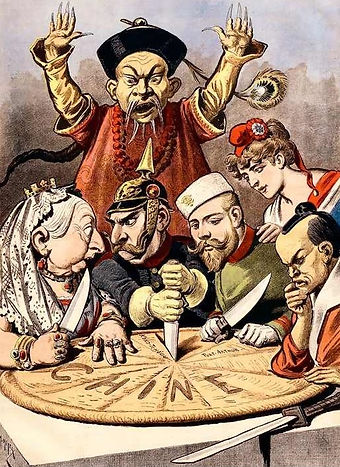
The most powerful nations of the world, such as Great Britain, the United States, France, Japan, Germany, and Russia, had established Spheres of Influence at individual Chinese ports. These were like miniature European countries with their own set of laws and protections established on the Chinese mainland. Inevitable foreign encroachment through national competition and sometimes the enforcement of outright evil, such as the Opium Wars, naturally resulted in feelings of anger, hostility and resentment on the part of the Chinese. However, any attempt at direct resistance at such measures always resulted in defeat for the Chinese and more power for the outside Western world. But as their individual home countries gained power, the missionaries of those countries received greater protection and opportunities to expand their ministries inland. Though missionaries had a different motive than the merchants and imperialists, they were often viewed by the Chinese as one and the same.
Right: A cartoon of that day depicts China being carved up by outside nations
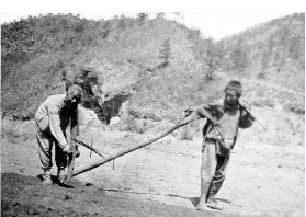
Peasants farming. Due to the consequences of Confucianism, China remained trapped in the philosopher's time period as they saw no need for change or improvement even in daily technology.
At the turn of the 20th century, several natural disasters took place in China simultaneously. The Yangtze River experienced unprecedented flooding coupled with the worst drought conditions ever experienced. The native Chinese were unable to grow crops and starvation was rampant. The countryside population that would normally be working the fields were now idle and starving. The many who still clung to superstitious traditions believed these conditions were caused by the spirits of angry ancestors who must be appeased. The Western advances of the telegraph and railway, which was not in keeping with China’s ancient way of life, disturbed the ancestral graves, and destroyed the carefully balanced societal feng shui had to be destroyed in order to restore harmony.
This gave rise to the Righteous and Harmonious Fists, a secretive nationalist society within China which sought to maintain and restore the old ways. They were given the moniker “Boxers” due to their distinctive style of hand-to-hand combat training. During frenzied ceremonies they offered themselves up to be possessed by what they believed to be the spirits of their ancestors. They believed such dedication would make them impervious to Western bullets and undefeatable in combat. Boxers viewed missionaries as “first class devils,” their Chinese converts as “second class devils,” and anyone associated with Western powers through trade or employment as “third class devils.” All such devils had to be exterminated. As drought conditions worsened, unrest in the country grew and the ranks of the Boxers swelled.


The Righteous and Harmonious Fists, better know as Boxers, and Dowager Empress Cixi were a match made in hell.
Their hands are stained with the blood of the martyrs. But "the blood of the martyrs is the seed of the Church" (Tertullian)
Though China was ostensibly under the rule of the Qing Emperor at this time, the real power behind the curtain was an evil woman known as the Dowager Empress Cixi. Through scheming, murder and intrigue, this woman had impossibly risen from being a mere palace concubine to achieving the heights of power and she was not about to concede any of it. She hated all things Western, especially Christianity and saw the Boxer movement as just what she needed to expel the foreigners and eradicate all Christians, both missionaries and Chinese converts.
When she felt everything was in place, the Dowager Empress sent this message to the governors of her provinces: “Whenever you meet with foreigners you must kill them, and if they attempt to escape you must kill them.” Thus, was unleashed the most violent coordinated attack on Christian missionaries in modern times. Over the course of the next year, untold thousands of Christians in China would be mercilessly slaughtered. The bloodshed would only end upon the intervention of an eight-nation coalition which culminated in the saving of missionary holdouts at the British legation in Peking from certain death in August of 1900.
“Do not be afraid of what you are about to suffer. I tell you, the devil will put some of you in prison to test you, and you will suffer persecution for ten days. Be faithful, even to the point of death, and I will give you life as your victor's crown.” Revelation 2:10
Though it is impossible to put exact figures on the number of Christians that were killed in China during this turbulent period, the letters and eye witness accounts of those who received their “victor’s crown” are an inspiration and eternal living monument. Here, then are some of their stories we share in the effort to Let Their Light Shine:
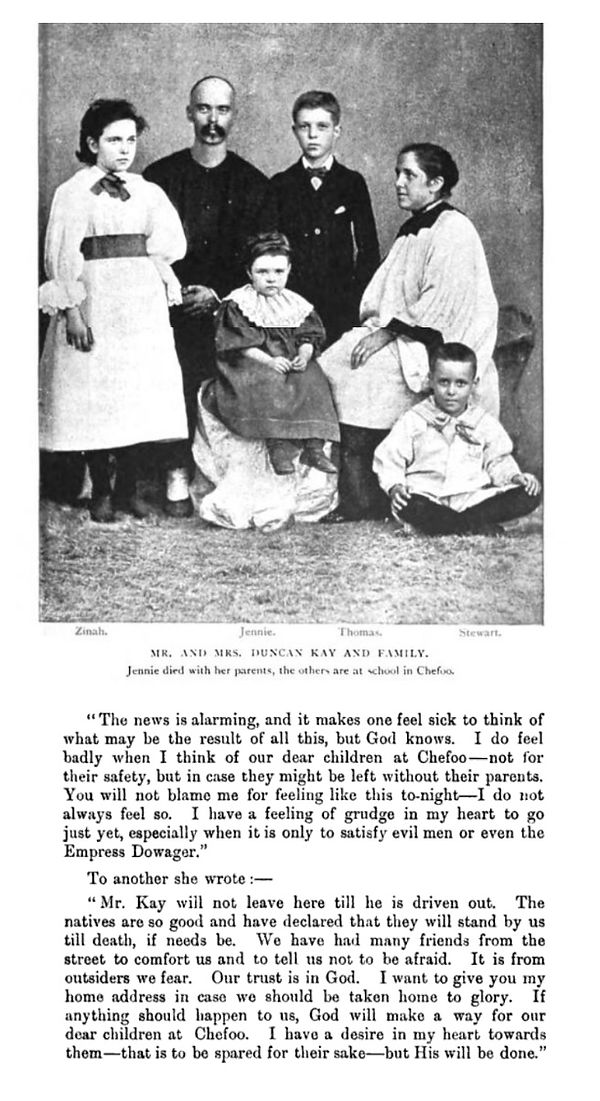
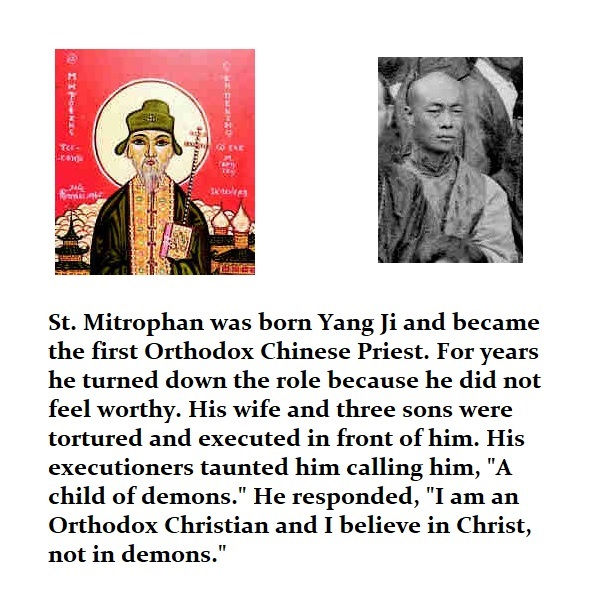


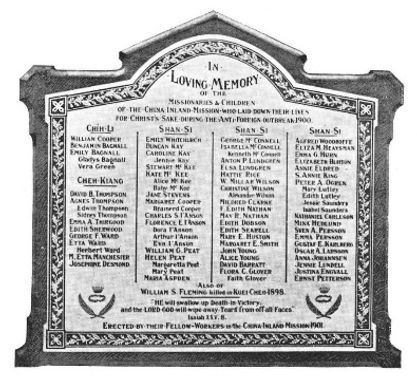
The China Inland Mission was founded by J. Hudson Taylor in 1865. Though it covered 14 out of China's 16 provinces, it never experienced a death until 1898. This was the first of the 52 adults and 16 children associated with the Mission that would suffer martyrdom during the Boxer Rebellion. This was out of over 800 missionaries assigned through CIM.
But far from destroying the Mission and the work of missionaries in China, the Boxer Rebellion set off The Golden Age of Missionary Work in China and within the next 25 years, thousands of new workers for the Lord would fulfill their role in this foreign land, taking up Hudson's challenge:
“Let us pray that the record of these sufferings may stimulate us to greater self-denial, and that Christ’s people in the home-land may share in the coming blessing, and let us never forget that a million a month in China are dying without God.”
- J. Hudson Taylor, December 1900