


Lottie Moon: "The Mother of Missions"
Daily Threads

aily

hread
Thread One: Christian Missionaries Have Made the World a Better Place
"Let your light so shine before men, that they may see your good works, and glorify your Father which is in heaven."
Matthew 5:16
In describing any sort of human endeavor, it's customary to begin with the obligatory disclaimer “Of course, there were some errors in judgement and occasional wrong actions taken....” The task of spreading the Good News about an infallible Savior by fallible human beings will inevitably lead to such occasions. However, it is the very nature of the Gospel provided in the example of Christ which causes us to be open to such introspection and correction when necessary. It is this attitude that can prove most effective at winning the unconverted to the Truth.
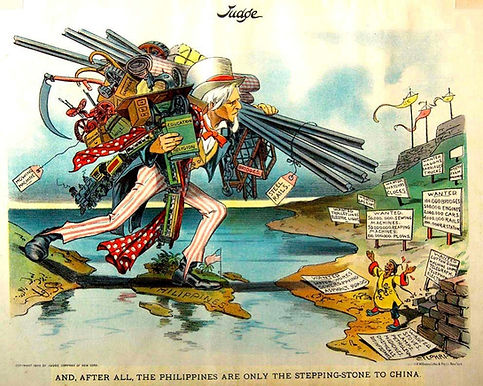
In today’s society, the work of pioneering Christian missionaries is often erroneously lumped in with the negative actions of colonial imperialism. This is an unfair mischaracterization. In reality, missionaries were often thwarted in their efforts by European powers who saw the desired result of such missions would be to put an end to the ignorance and exploitation of the local populations. To this end, hindering laws were enacted, travel to and within foreign lands was restricted, legal protections were withdrawn or unenforced, and angry diatribes were issued.
Photo: Vintage cartoon depicting Religion and Education being brought to China along with American Imperialism

Contemprory cartoon depicting the monstrosity of British Imperialistic overreach
In order to protect the inevitable destruction of the slave trade from these missionary do-gooders, in 1793 the shareholders of the British East India Company pushed the following resolution through Parliament:
“That the sending of missionaries into our Eastern possessions is the maddest, most extravagant, most expensive, most unwarrantable project that was ever proposed by a lunatic enthusiast. Such a plan is pernicious, impolitic, unprofitable, unsalutary, dangerous, unfruitful, fantastic. It is opposed to all reason and sound policy; it endangers the peace and security of our possessions.”
Missionaries throughout the ages who have sacrificed worldly goods, fame, and fortune, have improved the lives and wellbeing of those they labored for in ways that are often overlooked, intentionally ignored, or miscredited to others.
Photo: A Missionary's Humble Lodging in China


Painting: A Converted British Family Sheltering a Christian Missionary From Persecution by the Druids
by William Holman Hunt 1849-50
The pejorative accusation that missionaries sought to turn natives into copies of Europeans ignores the fact that before the civilizing effect of Christianity reached the pagans of Europe more than a millennium ago, the inhabitants there were so brutal and barbaric that even the mighty Empire of Rome feared to cross its territory. It is the teachings of the Bible which overcame centuries of superstition that stifled progress and worked daily evil. It is Christianity alone which ended human sacrifice in these lands, which enshrined the nobility of individuals rather than clannish tribes, which exalted the status of women, and established standards of moral behavior that enabled cultural phenomenon such as the Renaissance and the Industrial Revolution to take place. Christianity, in essence, created what we now think of as Europe. And it was from these European lands that missionaries then arose to share this same Good News which can yield the same godly results in any other nation on earth.

The Missionaries of Hudson Taylor's China Inland Mission adopted Chinese dress and style in an effort to better relate to the local population, thus following Paul's example in I Corinthians 9:22 "I have become all things to all people so that by all possible means I might save some." (NIV)
Because Christianity is based on the teachings of a book, namely, the Bible, which can be readily explained and comprehended by others, Missionaries realized the value in education. The maps they created, the journals in which they recorded observations, the articles and letters which they sent back home, all helped to shine the light on what was previously hidden in darkness. Missionaries were able to use this foundation to reach tribes with no written language and created alphabets with which to record indigenous history, improve communication, and print tracts and pamphlets to share the Good News with such learning. Wherever Christian missionaries went, knowledge increased.
Photo: A Missionary School in 19th Century China
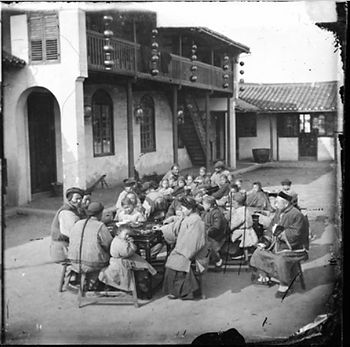

Because Christianity values each individual human life as uniquely created by God, Missionaries drew attention to ungodly behaviors, standards and traditions which devalued life. For the first time in these foreign lands, orphanages were established, leper colonies were created to care for outcasts, charities and social programs that taught new skills were set up to care for the widows and prostitutes who had no one else to depend upon. Evil practices which especially negatively impacted women such as sati or suttee (the practice of burning a widow on her husband’s funeral pyre) and foot-binding fell out of favor. Wherever Christian missionaries went, “the least of these” found comfort and care in ways they had never before experienced.
Painting: Robert Moffat, 1795 - 1883. Missionary (With John Mokoteri and Sarah Roby)
Not long after the death of their first son while serving in Africa among the Bechuana tribe, Robert Moffat and his wife heard the cries of an infant from a hillside near their mission station. When they investigated, they found a baby girl placed in a shallow pit with a stone covering her. Abandoned by her family and left to die, the baby had scratch marks on her face and hands where she had tried to claw her way out of her own grave. Moved to compassion, the Moffats took the baby with them and lovingly nursed her back to health. Mrs. Moffat recorded the attitude of the villagers in a letter back home, "They viewed it with indifference; said the mother was a rascal, but wondered much that we should love so poor an object." The little girl's mother and grandmother, who had carried out the dastardly deed, were known to the Moffats and had even received food from them on the day they had committed this evil act. The Moffat's adopted the little girl, named her Sarah Roby and educated her. Several years later, on their return to the UK, Sarah Roby became a celebrity on the speaking circuit and testified to the unconscionable conditions in pagan lands and for the need for more missionaries to answer the call to save lives and souls.
The Moffats adopted their son, John, from the Khosian tribe. John was a baby when his mother died, and as was often the case for orphans, he and his infant sibling were about to be buried alive with their dead mother when they were rescued by the Moffats.
Because of the miraculous leap in technology Europeans had experienced as a result of the practice of Biblical principles, their improvements in agriculture, building technology, and sanitation were shared on foreign mission fields. Missionary societies found great success through such indirect evangelism, especially with doctors and nurses who answered the call. The Christian principle of private property was established in foreign lands which helped protect natives from exploitation from outsiders. The Christian emphasis on living a life pleasing to God saw an increase in productiveness and the enshrinement of morality and the championing of principles which establish a functional society. Wherever Christian missionaries went, technology and daily life improved.

A Medical Missionary Lecture in China
Of course, the primary goal of missionaries is the winning of souls for Christ and the planting of self-sufficient local churches overseen by native converts. But just as we do not live one-dimensional lives, the multifaceted role of missionaries brought about a spiritual and cultural revolution in the societies in which they ministered. The nations throughout the world which have been freed from the bonds of barbarism and the snare of superstition owe this blessing to the miraculous power of the Gospel and the selfless sacrifice of Missionaries who abandoned their own will to follow Christ’s command to “Go and Tell.”

Well Done, Good and Faithful Servants!
These are just a few of the countless missionaries who have given their lives to the cause of Christ and, in so doing, made the world a better place.

Gladys Aylward (1902-1970)
Gladys felt called to be a missionary in China, but after initial training from China Inland Mission, she was turned down due to her lack of progress in mastering the Chinese language. Undeterred, she took a job as a domestic servant until she had saved enough money to make the dangerous trip to China by train through Siberia. Upon finally arriving in China, she found work with an older female missionary at The Inn of Eight Happinesses where they shared the Gospel as they served fellow travelers. Eventually she became a government "foot inspector" and was able to travel the countryside to enforce laws against the horrible practice of foot binding, which enabled her to further share the Good News of Christ. She eventually started her own orphanage, and, when the Japanese invaded in 1938, Gladys led over 100 orphans through dangerous mountain passes to safety. A popular Hollywood film based on her life called The Inn of the Sixth Happiness was released in 1958.
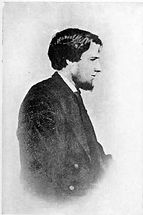
Timothy Richard (1845-1919)
Timothy was one of the most influential missionaries to China in that he was able to effectively bring about positive cultural change at high levels. He proposed using the indemnity paid to Britain after the Boxer Rebellion to create Shanxi University. He was so admired for his wisdom and foresight that he became an advisor to the Qing Dynasty and put forward measures to eradicate foot binding and raise the status of women. He became a contributor to the monthly Chinese publication Review of the Times (Wan Guo Gong Bao). In this capacity he wrote articles which provided practical applications of Christianity within Chinese culture. His writing showed how Christianity was key to China's advacement in economics, civil justice, and quality of life and led to the conversion of many, including those in high government positions.

Amy Carmichael (1867-1951)
Even while suffering from a painful disease, neuralgia, which left her incapacitated for weeks at a time, Amy served as missionary to India for over 55 years - without ever once taking a furlough. As a missionary, Amy found her special calling in saving young children, especially girls, from a life of untold evil serving in Hindu temples. She opened her own mission, Dohnavur Fellowship, which soon became a refuge for thousands of children fleeing a life of forced prostitution, starvation, and destitution. In response to a young woman's inquiry into the life of a missionary, Amy responded, "Missionary life is simply a chance to die." Through her books and testimony she served as an inspiration and role model to future generations of missionaries. When the children she worked with were asked what drew them to Amy, they responded, ""It was love. Amma ("mother") loved us."

Hampden Coit DuBose (1845-1910)
The work that H.C. DuBose put into stopping the opium trade in China saved untold millions of lives. Opium addiction was the greatest destroyer of the Chinese throughout the 19th century. In some provinces, up to 90% of the population were users. Addicts would do anything to acquire money for their habits - even selling their wives and children into slavery. As founder of the Anti-Opium League in China, DuBose and his fellow missionaries gathered facts and statistical information proving the destructive effects of opium and documenting its devastation in China. This report was forwarded to Parliament and led to the outlawing of the trade in 1906. DuBose then presented a petition signed by over one thousand missionaries to the Emperor who issued a royal edict forbidding the practice - using DuBoses' petition verbatim. A deadly scourge that had plagued the Chinese for decades was finally ended through the efforts of this honorable missionary.

Alice Seeley Harris (1870-1970)
Alice was a novice photographer when she came to serve as a missionary to King Leopold's Belgian Congo with her husband John. Though rumors of the horrible brutalities inflicted in the nation's rubber production had existed for years, Alice was able to document these atrocities with her camera. Her photos of the natives of all ages, including children, maimed with machetes for failing to meet production quotas found their way to the outside world and exposed what was really going on. Her fearless actions not only preserved the record of that terrible episode for all time, but helped bring an end to such barbarity.

Dr. Thomas Cochrane (1866-1953)
Dr. Cochrane arrived on the Chinese mission field just in time for the Boxer Rebellion. At great risk of his life, he jumped aboard an ox cart to travel to villages throughout the countryside to tend to their medical needs. After successfully treating high officials in the Dowager Empress's court, he received great favor and chose to use this opportunity for the benefit of China. Realizing that the needs of the vast population were far too great for medical missionaries. he put his efforts into creating Peking Union Medical College, the first medical school in China to train Chinese natives in Western methods. Towards the end of his long and productive life, Dr. Cochrane was able to testify, "All of my prayers have been answered."

Dame Edith Mary Brown (1864-1956)
Edith Mary Brown was one of the highest trained female doctors in Europe, having graduated with high honors from the University of Cambridge and the London School of Medicine for Women. She then volunteered for foreign missions and was assigned to Bombay, India. She was shocked upon her arrival at the horrendous medical conditions. Women were especially at risk and rarely received medical treatment because they were forbidden by Hindu culture from being examined by male doctors. To alleviate this disparity, Edith Mary Brown created India's first medical school for women in an old schoolhouse in 1894. Her efforts were so blessed, that by 1911 she was able to open Christian Medical College Ludhiana which provided treatment to the diverse Muslim, Sikh, and Hindu community. By its 50th anniversary, the school had graduated 411 doctors, 143 nurses, 168 pharmacy dispensers and more than 1,000 midwives.

Hunter Corbett (1835-1920)
Hunter Corbett believed in utilizing every aspect of life as an opportunity to witness for Christ. He founded a Boy's Academy that eventually became the first university in China. He emphasized carrying the Gospel to the remote outer regions of the countryside, rather than concentrating on the cities and he used unconventional methods in doing so. Noting the Chinese fascination with antiquities, he decided to incorporate this into his evangelism. He set up the first Chinese museum to display natural specimens the Chinese had never seen before. At his meetings, he would first preach a message to the assembled crowd and then open the museum for the curious onlookers. The displays were carefully planned in order to show the greatness, the design and the care of the one true God. For example, the native Chinese convert who served as lecturer would display a bird specimen and then talk of the importance of birds in Chinese agriculture and explain how a loving God had created this creature with its own purpose - and if such a seemingly insignificant bird could not fall to the ground unbeknownst to God, just think of how much more He cares for us.

Lilias Trotter (1853-1928)
Lilias was told by her mentor, the philosopher John Ruskin, that if she continued to develop her artistic talents ""she would be the greatest living painter and do things that would be Immortal." However, Lilias felt as if every time she prayed she heard the voice of God calling her to North Africa. Physically weakened after a surgery which permanently damaged her heart, she was unable to pass the requirements to be sponsored by any mission board. Undeterred, she joined with three friends who, in 1888, paid their own way and set up the "Algiers Mission Band" in what is today Libya. By 1920, the mission had grown to 30 missionaries in 15 stations. She chose to tailor her evangelism to the local culture by ministering in local cafes rather than European style church services and had scripture passages read to a rhythmic drum beat. As her health continued to deteriorate and she slipped into eternity, friends gathered around her and sang a hymn. Lilias suddenly exclaimed, "A chariot and six horses!" Someone asked, "You are seeing beautiful things?" "Yes!" this great missionary replied, "Many many beautiful things."
Eric Liddell (1902-1945)

In his own words, Eric Liddell was "born for China." Born in China to Scottish missionary parents, Eric would grow up to be an outstanding athlete. He won a gold medal in the 400 meters event during the 1924 Olympics, after refusing to participate in his best event, the 100 meters, because he would not race on a Sunday. Turning his back on a professional career in sports, Eric chose to return to the mission fields of China. Eric served as a teacher and used his athletic skills to connect with Chinese youth. When the Japanese invaded China, Eric was interred at a civilian camp where he died before the birth of his third child. Though conditions at the camp were often intolerable, Eric continued to be an inspiration to those around him even in such trying circumstances. As one of the survivors later said of Eric, "He was overflowing with good humour and love for life, and with enthusiasm and charm. It is rare indeed that a person has the good fortune to meet a saint, but he came as close to it as anyone I have ever known." Eric Liddell's Olympic story is told in the 1981 Oscar winning film Chariots of Fire.